
Phoenix Drone Pros
Blog
Pros and Cons of Drone Photography
In this article, we will give a detailed analysis of the pros and cons of drone photography.

Do you know that drones have been in existence since the 1930s? At that time, they were only used for military purposes to detect targets in hiding. However, in recent years, drones are no longer just allocated for military purposes. Civilians now use them for several purposes, one of which is photography.
Photography is an ever-evolving field that first emerged in 1822. It is tightly entwined with the technological advancement of gadgets used to capture images. It evolved from capturing still images to moving images and now to capturing images in areas that are not accessible to humans by the use of drones.
Drone photography has been prominent in recent years. The use of drones in photography has greatly advanced the Photography field, as one can now take impeccable photos of inaccessible areas. Like all other technological advancements in photography, drone photography has its pros and cons.
In this article, we will give a detailed analysis of the pros and cons of drone photography. Anyone with a drone photography dilemma should read until the end to gain enlightenment and clarity. For those curious about drone photography, your curiosity will be satisfied by the end of this article. So, read on!
Pros of Drone Photography
Access humanly inaccessible areas
Drone photography has eased the task of taking photos in areas that can not be accessed on foot. It has drastically eased aerial photography.
Before drone photography, planes and helicopters were and are still used for aerial photography. And as we all know, utilizing those is a costly undertaking.
With drones in photography, photographers and videographers can now take pictures and videos of areas that could not be accessed without a plane or helicopter.
High-resolution and low-to-the-ground scanning
Drones photography has greatly enhanced aerial photography. Drones can capture high-resolution shots from angles and points that were impossible before.
Every hidden detail in an area can be captured using drone photography because of the drone's ability to fly low to the ground. Their low-ground scanning ability gives them an advantage over other photographic methods.
Can safely fly to the ground
This is a natural advantage drone photography has over other photographic methods used to take pictures or videos of areas inaccessible by foot.
Drones can naturally fly safely on lower elevation points. As such, photographers can take high-resolution shots and capture minute details of landscapes.
Multiple elevation points
Drones have multiple elevation points. With drone photography, a photographer can take pictures of a particular area from different elevation points. This gives several different perspectives of a single area.
Can hover in one place
Unlike planes and helicopters, drones can steadily and easily hover in one spot till the perfect shot is taken. This is very important, especially for photographers obsessed with perfecting their shots.
Good drones are stable and sturdy enough to hover in a particular spot for about 30 minutes until the photographer gets their perfect shot. This gives drones an advantage over planes that can't hover in one spot for an extended period.
Can take detailed surveying data
Drone photography is the perfect way to get detailed surveying data. Drones can hover at multiple elevation points and give every minute and overall detail of a specific area.
Just imagine how cool that is. With drone photography, you can get as close to the surface area as possible and get detailed and enhanced shots. Likewise, you can hover the drone at a higher elevation point and get a wider shot.
Drone photography is undoubtedly perfect for obtaining detailed surveying data.
Cost-effective
Although not inexpensive, drone photography is relatively cheaper than other photographic methods used for aerial photography or to access areas inaccessible by foot. There are several reasons for this.
It does not require a staffed crew.
Drone photography does not require a staffed crew. Besides the pilot and cameraman, no other person is needed. This makes it way cheaper than planes that require a staffed crew. Moreover, manned crews are expensive and susceptible to injuries. With no need for a manned crew in drone photography, expenses and the possibility of injuries can be reduced.
Drones are relatively cheaper.
In the long run, drone photography is cheaper than planes or helicopters. Drones range from $100 to $1000 and more. Those that are more credit card friendly are not as good as the more expensive ones in terms of range, quality, and features.
A good drone can be utilized for years with proper maintenance. This is more cost-effective than flying planes or helicopters for aerial photography.
Maintenance is cheaper
Compared to planes, it is relatively cheaper to maintain drones. The most susceptible part of a drone is likely the battery. Additionally, drones do not require fuel or require hanger space expenses.
Compared to planes, drones can be said to be credit card-friendly.
Short time to deploy
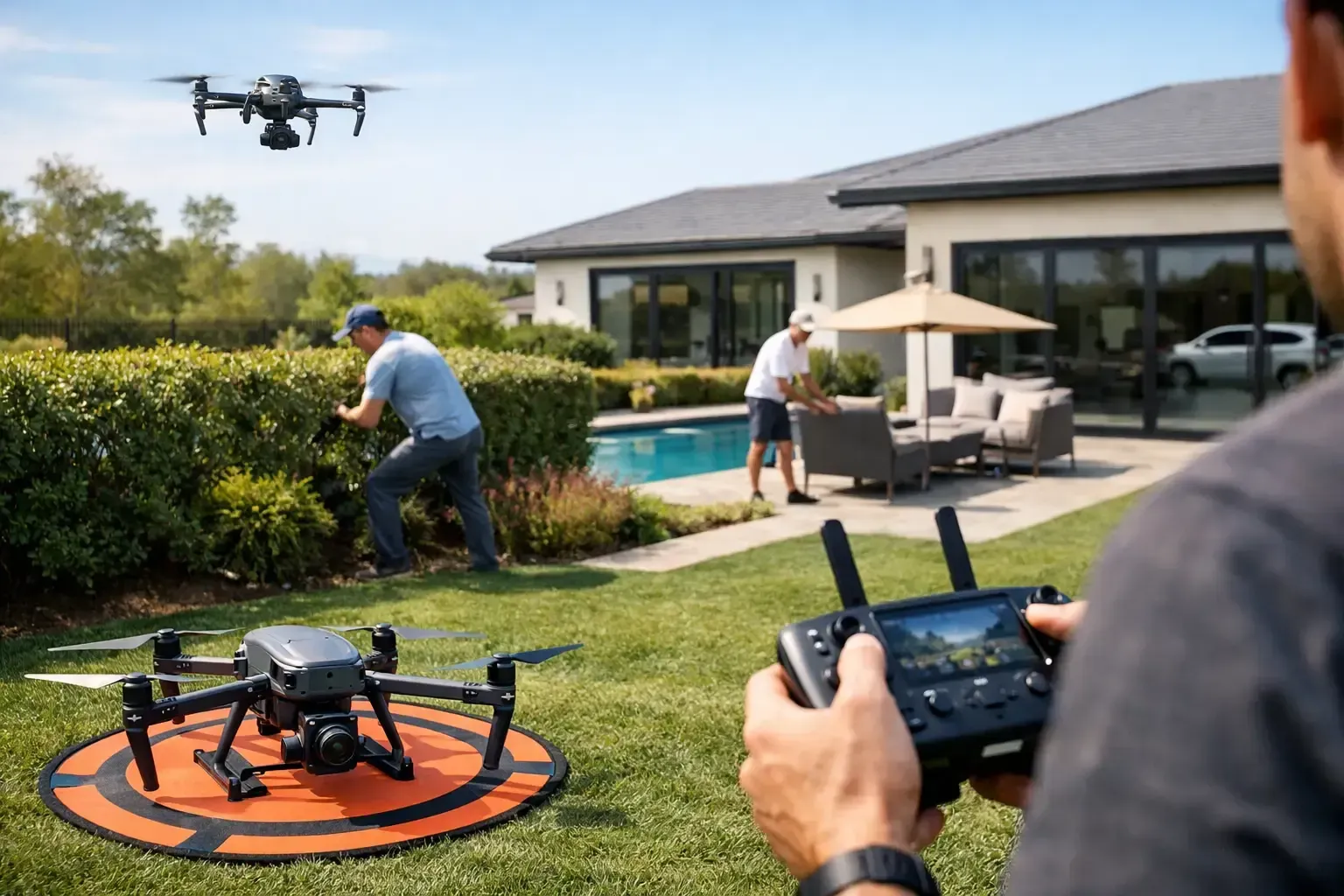
Drones take way less time to deploy than planes. This makes drone photography very convenient and easy for anyone to manage. With a competent pilot and cameraman, you are good to go.
Very mobile and easy to navigate
Drones are very mobile and easy to navigate. This makes drone photography relatively easier. Some drones way less than 0.55 pounds and do not require FAA registration.
Can easily operate in areas inaccessible by planes and helicopters
The size and weight of drones make them suitable for use in areas inaccessible by planes or helicopters. Drones can easily be operated and navigated within small areas to get remarkable shots that were never possible to get before.
It can be used for LiDAR and photogrammetric imaging.
Drone photography can be used for LiDAR and photogrammetric imaging. It is like shooting two birds with a single stone.
Cons of Drone Photography
Are limited in poor weather
This remains one of the greatest limitations of drones. Drone photography is limited in poor weather conditions like storms and high winds. Most drones are not heavy and sturdy enough to withstand very strong winds and storms.
In such instances, one must wait for the weather to normalize before sending out the drone for photography. Using drones in extreme weather conditions that will likely damage them is not advisable.
Limited flight time
Most drones can only run for about 30 minutes before shutting down. This is a great problem for photographers or individuals who intend to spend a couple of hours taking pictures or recording videos.
To rectify this, carry a power source or extra batteries so that you can keep the drone running for the extended time you need it.
Limited load-carrying capacity
Unlike planes, drones are not designed for heavy lifting. This limits the weight of the camera they can carry. Photographers who are very specific about the camera type can find this frustrating in some instances.
Although this can only partially be resolved, one can invest and get quality drones that can do the heavier lifting.
Limited access
Drones can not be used everywhere and anywhere due to regulations. In recent years, there has been an increase in regulations governing the use of drones. Drones are strictly prohibited in some areas, with limited use in others.
This has limited drone photography.
Invades privacy in some instances
This is one key disadvantage of drone photography. Although not intentionally, sometimes drones invade privacy while flying. The government has implemented several rules to prevent this.
No one wants to see a drone flying over or around their home and invading their privacy.
Not 100% safe
Like most tech gadgets, drones are not 100% safe. This makes drone photography risky, especially when switching between modes or landing. A malfunctioning drone can definitely cause injury to the human body.
Is it worth getting a drone for photography?
This is a very subjective question. So far, we have seen the pros and cons of drone photography. Although it has its cons, its pros are worth taking the risk to utilize for photography.
Drone photography is worth it. It has solved several problems in the field of photography that could not be solved by utilizing planes and helicopters. Moreover, drone photography is cheaper and only requires a moderately skilled individual to capture great photos.
Furthermore, drone photography has made it possible for citizens without any photographic background to take pictures of places they would never have dreamt of.
Conclusion
The use of drones garnered popularity in 2013 after Amazon publicized its intention to use them for delivery. Since then, drones have garnered popularity in several fields, including photography.
So far, we have seen the pros and cons of drone photography. Like all other tech gadgets, it has its advantages and disadvantages. However, its advantages outweigh its disadvantages.
As such, drone photography is especially good for one who wants high-resolution pictures or videos on a friendly budget. Drone photography has made it possible for citizens from various life classes to experience the hidden parts of nature on different budgets.
Thanks for reading till the end!