
Phoenix Drone Pros
Blog
Our real estate listing media guide explains which photos, drone views, video, and floor plans help buyers understand a property online before they visit.
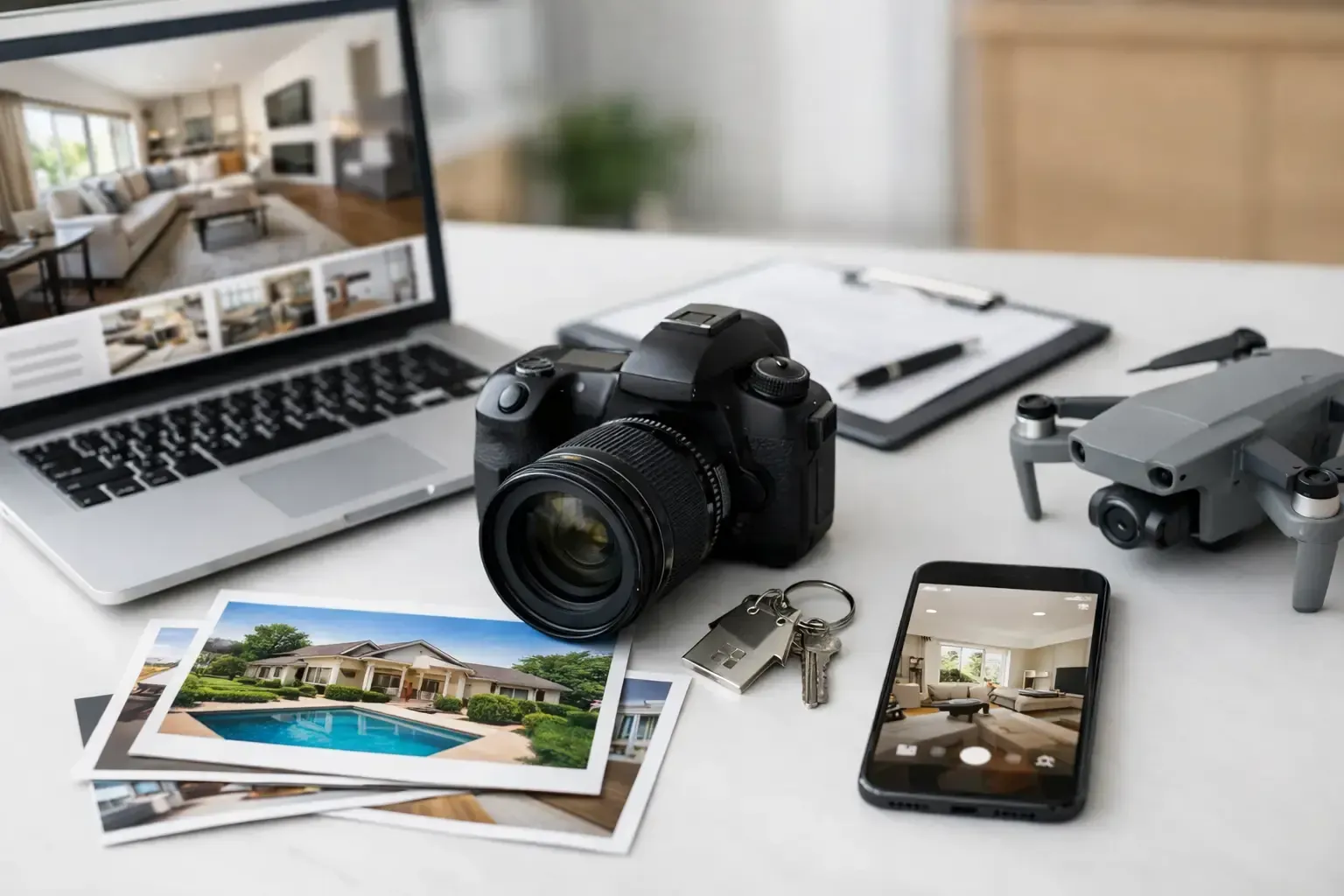
A listing can lose a qualified buyer before the first showing if its media leaves too much to guesswork. This real estate listing media guide is built for agents, brokers, developers, and property owners who need visuals that explain the property quickly, accurately, and in a way that earns attention in a crowded feed.
Good listing media is not simply a collection of attractive images. It is a sales tool that answers practical buyer questions: What does the property look like from the street? How do the rooms connect? How large is the lot? What is nearby? Is there a view, a pool, a detached garage, a rooftop, or commercial access that photographs from ground level cannot properly show?
The right mix depends on the asset, price point, target buyer, and marketing channel. A compact condo does not need the same production plan as a five-acre estate, a retail center, or a development site. The goal is to document the features that move the decision forward without making claims the media cannot support.
Build Listing Media Around Buyer Questions
Before scheduling a shoot, identify the property’s strongest selling points and the likely buyer’s priorities. For a residential listing, that may be updated finishes, a backyard, natural light, school proximity, mountain views, or a layout suited to multi-generational living. For commercial property, access roads, loading areas, parking counts, roof condition, nearby freeways, and parcel context may matter more than staged interiors.
Start with the listing story, not the equipment. If the key value is walkability, aerial footage alone will not communicate it. If the home backs to open desert or a golf course, a ground-level exterior photo may undersell the setting. When the story is clear, the media plan becomes more efficient and the final gallery feels intentional.
A practical pre-shoot review should cover the property address, access instructions, occupied or vacant status, desired delivery date, MLS photo limits, and any features that require special coverage. It should also identify restrictions early. Homes near airports, stadiums, military facilities, or other controlled airspace may require additional flight authorization or may limit what can be captured safely. Professional drone work means planning around those conditions, not arriving with assumptions.
The Core Real Estate Listing Media Package
For most residential listings, professional photography remains the foundation. Buyers typically scan still photos first, so the first image must immediately establish curb appeal, an inviting primary living space, or the property’s defining feature. A strong set of images then creates a logical walkthrough: exterior, entry, living areas, kitchen, bedrooms, bathrooms, outdoor spaces, and meaningful details.
Photography That Shows Scale and Condition
Wide-angle photography is useful, but it must be controlled. Overly distorted photos can make rooms appear larger than they are and create disappointment at the showing. Balanced composition, straight vertical lines, accurate color, and thoughtful lighting provide a more credible presentation.
Every image should earn its place. Photograph enough to show the full layout and condition, but avoid repeating nearly identical angles. Buyers need clarity, not a 60-photo gallery that hides the best features in the middle. For an occupied home, preparation has an outsized impact: remove personal clutter, clear counters, hide pet items, replace burned-out bulbs, and make sure all rooms are accessible before the photographer arrives.
Drone Photos for Context Buyers Cannot See
Aerial photography is most valuable when it provides real context. It can show lot size, property boundaries when appropriately presented, corner-lot positioning, backyard depth, proximity to open space, road access, nearby amenities, and the relationship between buildings on a larger parcel.
For higher-end homes, aerial images often establish the setting in a way street-level photography cannot. For commercial properties, they can reveal traffic routes, signage visibility, parking layout, ingress and egress, and surrounding development patterns. The best aerial images are not taken simply because a drone is available. They are selected because they answer a buyer’s question faster than a paragraph of listing copy.
Drone operations should be handled by an FAA-certified, insured operator who understands local airspace and site safety. This matters in the Phoenix metro area, where controlled airspace and changing conditions can affect flight planning. A professional operator will assess the location, weather, obstacles, people on site, and authorization requirements before launch.
Video That Creates a Sense of Movement
Listing video works best when it gives viewers a feeling for arrival, flow, and setting. A short, well-paced property film can move from the exterior to the main living areas, then out to the backyard or views, with aerial clips used to establish the neighborhood context.
Long video tours are not always better. A 60- to 90-second edit may be enough for a standard listing, especially when it is built for social media and mobile viewing. Larger estates, custom homes, hotels, industrial facilities, and investment properties may justify longer edits or several targeted versions.
The trade-off is production time and buyer attention. Use video to highlight what still photography cannot: the approach to the property, the connection between indoor and outdoor spaces, the scale of a great room, or the operational layout of a commercial site. Do not use fast camera moves or dramatic effects that distract from the asset itself.
Floor Plans and Matterport-Style Walkthroughs
Floor plans help buyers understand layout and room relationships. They are especially useful for homes with unusual additions, split-bedroom designs, multiple levels, or flexible rooms that may function as an office, gym, nursery, or guest suite. A clear floor plan can reduce confusion before a showing and help remote buyers decide whether the property deserves a closer look.
Virtual walkthroughs can add value when buyers are relocating, purchasing an investment property, or comparing several homes from out of state. They are not necessary for every listing. On a lower-priced or fast-moving property, excellent photos and a concise video may deliver better value. For luxury, new construction, furnished rentals, and commercial spaces, an interactive tour often gives prospects the confidence to take the next step.
Match the Media to the Property Type
Residential listings benefit most from a balanced package: professional photos, aerial images when the setting supports them, and video for homes where layout or lifestyle is a key selling point. A modest suburban home with no view or distinctive outdoor feature may not need extensive drone coverage. A home on acreage, near a lake, beside a preserve, or with major outdoor improvements probably does.
Commercial listings need a different approach. Brokers and investors want visual evidence of access, visibility, surrounding tenants, parking, loading, building condition, and neighborhood growth. Aerial video can provide valuable context, while ground photography documents interiors, equipment areas, entrances, and finish level. For development land, current aerial imagery and progress documentation can help communicate site readiness and the broader opportunity.
For construction and new development, consider capturing media at key milestones rather than only at completion. Progress photos, aerial maps, and short update videos can support leasing, investor communication, marketing, and project records. Consistency matters here. Capturing similar angles over time makes change easy to see.
Plan for a Clean, Efficient Shoot Day
Even the best camera cannot solve a poorly prepared property. Confirm that the landscaping is complete, vehicles are moved, gates are unlocked, pools are clean, and exterior lighting is operational. Schedule around the property’s best light when possible. Twilight photography can be effective for select homes, but only when the exterior, landscape lighting, and pool areas are ready to be shown.
For occupied properties, agents should set expectations with sellers. Pets need to be secured, personal photos and sensitive documents removed, and residents out of frame. On commercial sites, coordinate with facility managers so that shooting does not interfere with operations or create safety issues around vehicles, crews, or active equipment.
Turnaround time also needs to match the listing launch plan. If photography, video, drone footage, and a floor plan are scheduled separately, the property may sit without a complete marketing package. Coordinating deliverables from the start supports a stronger first impression when the listing goes live.
Use Media Honestly and Put the Best Frame First
High-quality media should create interest, not confusion. Avoid misleading property-line graphics, heavy sky replacements that change the feel of the day, or extreme editing that hides visible defects. Aerial images should provide orientation and context, with clear labeling when boundaries or nearby features are shown for reference.
Lead with the image that best represents why someone should care about the property. That may be the front elevation, a bright kitchen, a view, a pool, or a compelling aerial perspective. Then make the rest of the gallery easy to follow. The buyer who understands the property before arriving is more likely to schedule a showing with realistic expectations.
A thoughtful media package does not need every possible deliverable. It needs the right evidence for the property in front of you. When the visuals are accurate, well-planned, and professionally captured, they give serious buyers a reason to stop scrolling and take the next step.